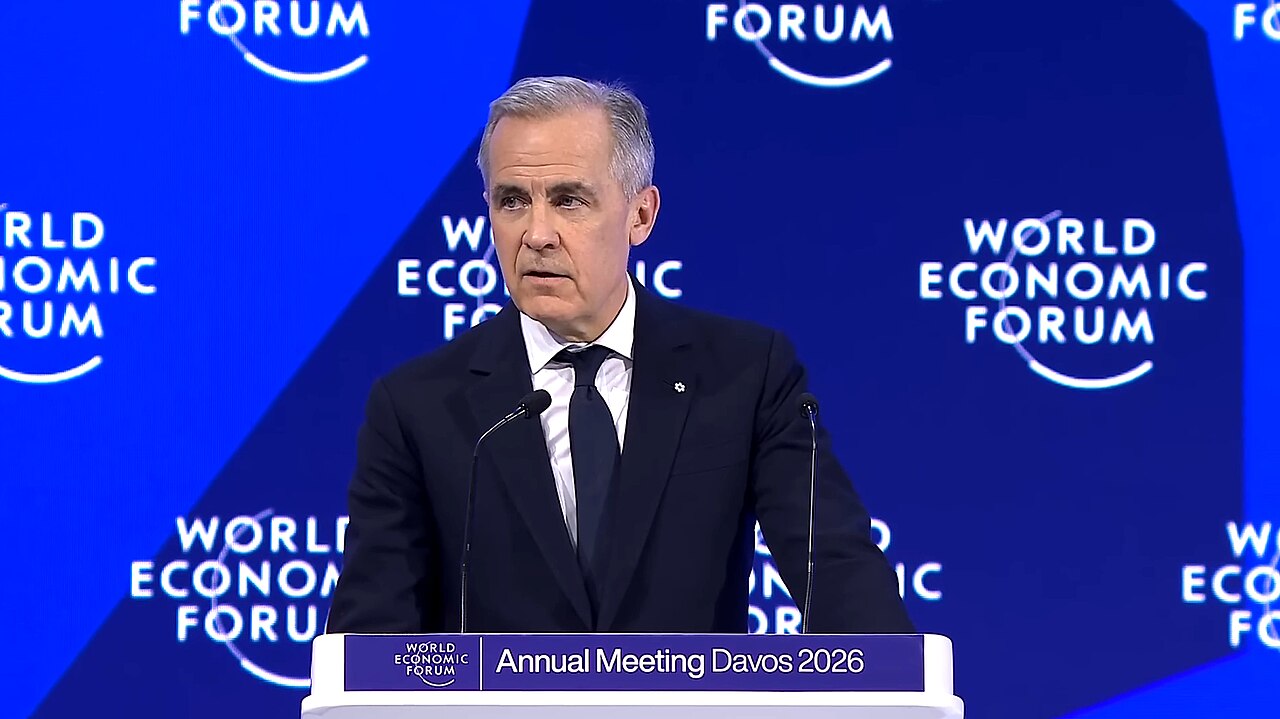
Prime Minister Mark Carney’s address at the World Economic Forum in Davos, Switzerland, on January 20, 2026 where he told the audience about “the rupture in the world order, the end of a nice story, and the beginning of a brutal reality where geopolitics among the great powers is not subject to any constraints.”
Carney’s speech was remarkable because he openly spoke about what many leaders were reluctant to say out loud. In a world increasingly divided by the rivalry between superpowers, Carney argued that middle powers like Canada could no longer afford passivity, he urged middle powers to stand up and work together to chart a new path forward.
Middle power countries do play a vital role in international relations. At the 2024 Davos gathering, Dino Patti Djalal, Founder and Chairman, Foreign Policy Community of Indonesia, said that the 21st Century would be shaped by middle powers because of their growing numbers. These countries can advance their national interests, using their commitment to multilateralism to contribute to global economic stability and security.
While there is no single definition of what constitutes a middle power, those generally considered to be a middle power include Australia, Canada, South Korea, Argentina, Turkey, Brazil, India, Japan, and Indonesia and at least 18 countries in Europe, excluding Germany, France and the U.K.
Canada is well positioned to be a leader to leverage a coalition of middle powers going forward, after all, we have done this before. When World War II ended in 1945, Canada utilized effective diplomacy at the UN, advocating for a seat at the table, which led to former prime minister Lester B. Pearson serving as president of the UN General Assembly in 1952 and 1953. Pearson pushed for the UN to lead a peacekeeping mission during the Suez crisis, and not long after the war, participated in early talks that led to the creation of NATO.
That history is important today. Carney can lead by example to other middle powers by reinforcing support for multilateral institutions, including the WTO, the UN and COP, the United Nations Framework Convention on Climate Change.
We can help other middle powers to forge new relationships and coalitions with governments to advance their own strategic agenda. This will mean new trading partners and building new diplomatic relations that may not share values, based on a relationship with shared interests. This will take time and a lot of work; however, given the current global upheaval, it is the only viable path forward.
Carney noted in his Davos speech that Canada has what the world needs: energy, critical minerals, an educated, multilingual, multicultural workforce (which also happens to be uniquely located).
Canada has several existing arrangements with countries around the world, both unilaterally to larger multi-nation agreements such as the CPTPP. And earlier this month, Carney travelled to China and Qatar to secure new commitments.
While these new relationships create much unease in many circles, Canada cannot afford to retreat. We must continue down this path to secure our own future and support other middle powers to do the same.
“If you are not at the table, you are on the menu,” Carney warned at Davos. The speech at Davos has the world talking; Canada must step up and lead middle powers to chart a new path to ensure our place at the table.