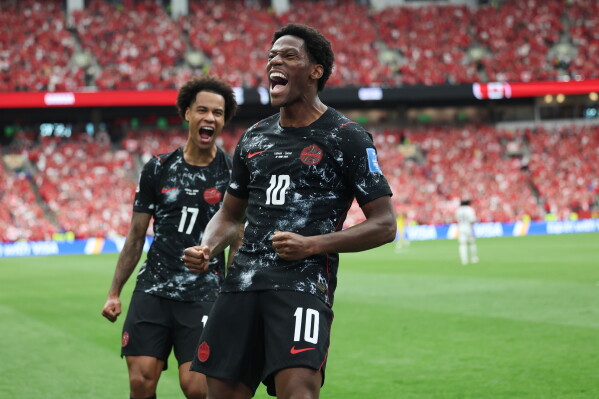
On June 18, 2026, something happened in Vancouver that I don’t think any of us were fully prepared for.
Canada beat Qatar 6-0, scoring more goals than any CONCACAF nation in World Cup history. I watched it with the kind of disbelief that slowly turns into something much bigger: the realisation that you are witnessing a moment your country will talk about for a generation. This is our first-ever World Cup win, and comes on the heels of Canada’s first-ever World Cup point against Bosnia-Herzegovina six days earlier. Right now, Canada sits at the top of Group B.
This has become about more than a game.
Over the last week, I’ve felt something I don’t reach for often: a deep, uncomplicated pride in this country. Right now, Canada feels enormous and full of hope.
There is something about the World Cup that cuts through everything else. The noise, the flags, the strangers hugging each other in the street. In a year when the news has been relentless and the world has felt genuinely fragile, watching a country united by nothing more complicated than the love of a game feels like a small act of restoration.
That is what soccer, aka football, does. It always has.
The 2026 FIFA World Cup is the first in history hosted across three nations—Canada, Mexico, and the United States. Three countries, one tournament, one shared stage for the world. Billions of people across the globe will tune in, making it not just the largest World Cup ever but one of the most watched sporting events in human history. With 48 teams and 104 games played across 16 cities, the scale is staggering. For soccer fans, the World Cup has always meant something beyond the game itself: national pride, shared identity. A rare moment when the world actually shows up together for one thing: the love of the game.
The irony is almost too on the nose.
Because off the pitch, these three co-hosts are barely on speaking terms.
The joint bid to host the World Cup was won in 2018, when Canada, Mexico, and the United States successfully beat Morocco for hosting rights. Trump was in his first term then, making noise about NAFTA, and rattling the alliances that had held North America together for decades. But the three countries set that aside long enough to put together a winning bid. They found a way to cooperate.
However, a lot has changed since then.
Trump has threatened military action against Mexico over drug cartels. He has called Canada a “51st state,” which never was regarded as a joke here at home. He slapped both neighbours with tariffs and, as recently as June 10—less than three weeks before the CUSMA (Canada-U.S.-Mexico Agreement) review deadline—told reporters he was not looking to renew the trade deal. “We don’t need anything that Canada has. We don’t need anything that Mexico has,” he said.
CUSMA covers roughly $1.3 trillion in cross-border trade and protects about 90 per cent of Canada’s exports from U.S. tariffs. Minister Dominic LeBlanc, who is heading up the trade talks for Canada, has signalled cautious optimism that negotiations are progressing and that talks will continue past the July 1 deadline. Let’s hope that optimism is well-founded, because the rhetoric coming from Washington does not exactly invite confidence.
As I’m writing this, all three soccer co-hosts are still very much in the running as the group stage continues. I’ll be watching all of it—and hoping that the spirit in the stadium stands is found in the rooms where the real decisions for trade get made.